

One of the things I’m trying to do as I develop Paper Drum is put into practice all the stuff that I’ve been doing over the last couple of decades in enterprise product delivery.
Probably the thing that brings it all together in my mind is a training course that I’ve been delivering for some time called the Advanced Professional Scrum Product Owner class. Now, this class doesn’t talk about theory at all. It assumes you know all that. Instead, it delves into the six stances of effective product ownership. I was delivering this class over the last couple of days, and I realised that when it comes to the customer representative and understanding customers, I’ve been breaking several of my own rules.
Now, I’ve been quite deliberately following the advice that I’ve been giving. One of the key bits of advice is that you’ve got to get out of your own head. You’ve got to talk to real users and understand customers. And so, at a very early stage in the development of Paper Drum, I scheduled half a dozen calls with people I know: people I’ve worked with in the past, even family. People who are supportive of me, and therefore I can take their praise with a pinch of salt and try to tease out criticism.
You’ve got to get out of your own head.
Now, some of these interviews did prompt some useful information. For example, one user opened the product up - in my head, this was something that you would open up, you would play around with, you would improvise some melodies or some music or some drum rhythms. You would explore, you would be curious. But for somebody that had never seen my product before, they saw a piano keyboard as the first screen. Instinctively, they tried to play a tune that they knew, a simple melody, and they couldn’t, because it wasn’t set up that way. That wasn’t a good experience, and then they didn’t really know what to do. So based on that, I understood that it would be better to have some sort of introductory learning segments: somebody teaching you a rhythm, and then easing you into making up your own things.
Another useful thing that came out of these interviews was a question I’d scripted, which did work quite well: “would you be prepared to use this for a week and give me some feedback at the end?” And somebody said, “Well, actually, you know, I’m supportive of what you’re doing, but actually, no, I wouldn’t. And the reason is that as it is right now, I can’t really see the point of it. There’s nothing to say why it would be worth it, why I would come back time after time.”
As it is right now, I can’t really see the point of it.
So that gave me really useful insights into developing something that would answer that question. What would I do? Why would I come back to this? That prompted me to build a learning pathway that would lead into the ability to develop your own rhythms, and then potentially share them with others, and then come back to it.
But as I was teaching the [advanced product] class just over the last couple of days, and reiterating the advice about how to talk to customers, how to talk to users, I realised I was doing several things that I was telling the class not to do.
I realised I was doing several things that I was telling the class not to do.
Firstly, I was solving problems there in the call. At one point in the discussion, somebody said that they couldn’t see what they were supposed to be doing. Rather than just note that and thank them for the feedback, I proceeded to talk them through it and demonstrate. Now, this is a good thing to do, and I think any product needs effective support. You need a way for people to figure out what to do. But the trouble is that if you do that in a conversation where you’re trying to learn about what’s working in the product and what’s not working, that information then doesn’t come through. The focus of the conversation is “let me show you this” or “let me explain that”. That doesn’t leave space for “here’s what I think, this is my experience”. And that’s the stuff that you want. That’s the stuff I was looking for.
The other mistake I made is that I was essentially pitching the product. I was explaining my idea of how music in the past was participatory. People used to join in, whereas now it’s more productised. It’s something you buy, it’s something that you listen to. And I was describing all the different options that I thought this product might be useful for. I was saying, well, it could be used in office teams, in groups. It could be used in meetings as an icebreaker, with groups of people making music together. Or it could be used as an individual activity: you might sit down and get into the right frame of mind before doing some work. And that meant that I wasn’t getting the sort of raw, unvarnished response. I wasn’t hearing how people received the product as it was.
I also totally abandoned my plan to observe. In my script that I prepared before these interviews, a big part of it was supposed to be asking the users to open up the product, have a play with it, and let me observe them. But at the time, I just decided against it. I just asked them to describe how the product was and tell me a bit about what they thought about it.
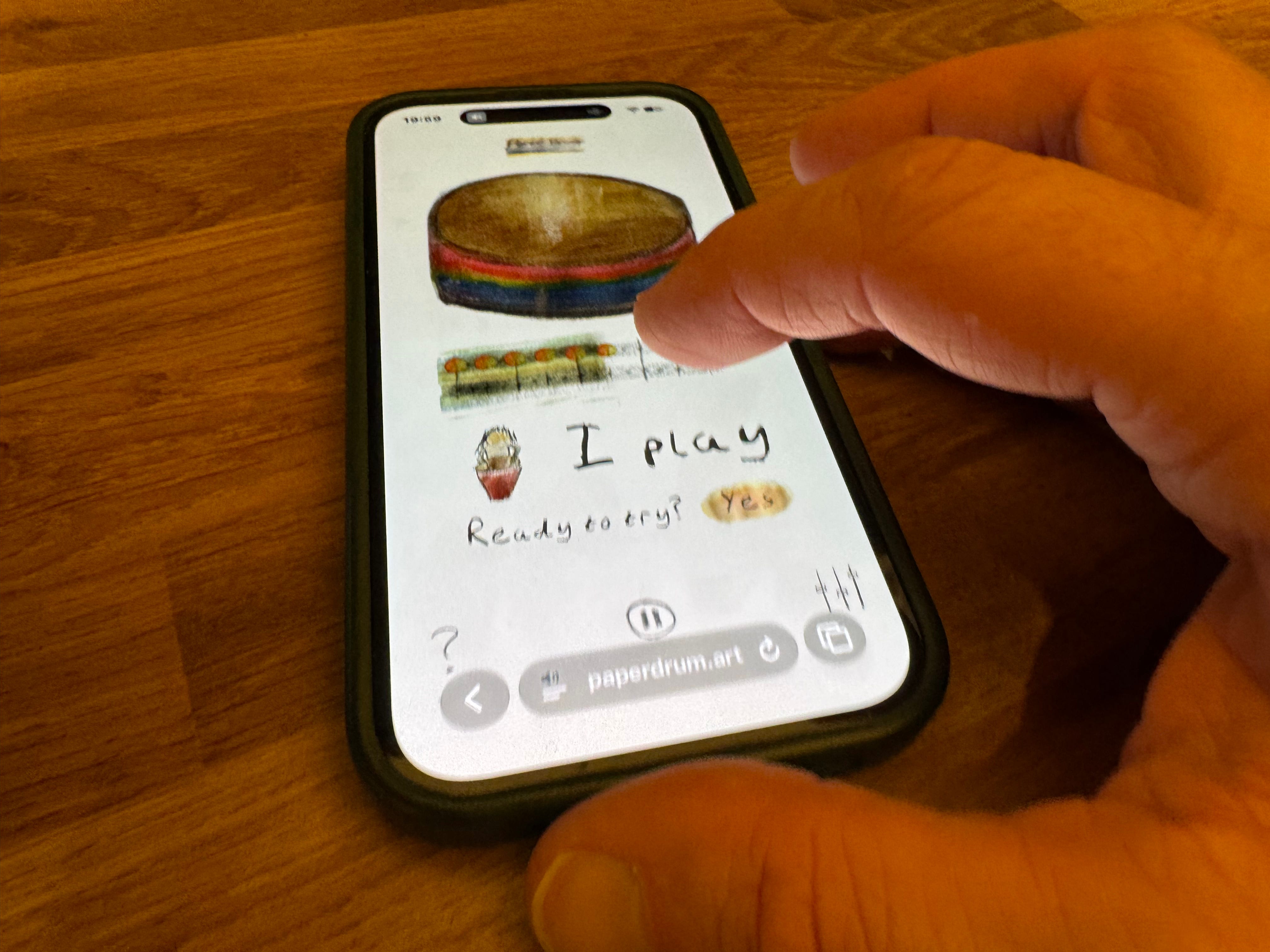
But it was only a chance encounter later on. I was having lunch and mentioned the product, and somebody was curious. So I got my phone out, put it on the table and allowed them to have a look at that revised opening journey. It was only the fact that I was there watching a user that made me see that it was still not quite right. The sequence was too fast. It advanced onto the next stage before an uninitiated user had worked out what the idea was.
So it just shows that taking the opportunity to actually see real customers, meet real customers, real users in situ, is absolutely priceless.
There’s an old truism in user experience design: you are not your user. This is something that people have been talking about long before it was so cheap and quick to create products. Right at the heart of that idea is that in your head, as you’re building a product, or anything (it could be an article, it could be a blog, it could be a painting, anything you’re creating, anything you’re making, or any idea that you have), it’s only when you show it to somebody else that you get some sort of insight as to whether this is just for you, just something that’s interesting for the person making it, or whether it might be something that others might find value in.
There’s an old truism in user experience design: you are not your user.
So at a time where it’s so quick and so cheap to create, there’s therefore so much stuff. Anybody involved in trying to create value for others, you need to make the opportunity to share regularly, share widely, get inputs, get feedback. But it’s not enough just to have the conversation. You’ve got to do it right. You’ve got to do it well. You’ve got to try to make sure that you’re actually gaining the insights that you need to get.
And I think really, this is the difference between a hobby product and a product that might stand a chance of being used by somebody other than its creator.